
Your Marketplace health insurance payment can change for 2027 because the plan’s full premium, your available financial assistance, or the household information used to calculate that assistance can change. A change in what you pay does not mean the insurer is pricing the plan around a change in your personal health.
This article addresses ACA Marketplace coverage. Medicare premiums and employer health benefits follow different rules and deserve their own review. If your household has more than one type of coverage, keep those decisions clearly identified.
- Separate the full plan premium from the monthly payment after any available assistance.
- Marketplace insurers cannot base your premium on your health or medical history.
- Update expected household information for the coverage year and check current eligibility.
- Compare doctors, prescriptions, deductibles, and other costs before choosing a lower premium.
- Use your actual renewal information rather than a national headline to explain your payment.
Why can the bill change when I am still healthy?
It is understandable to wonder why a health insurance bill changed when your own circumstances seem much the same. But your payment reflects more than the care you used last year. The plan has a price for next year, and the amount you personally pay may also reflect financial assistance.
HealthCare.gov explains that Marketplace premiums can reflect factors such as age, location, tobacco use, the plan category, and who is covered. Your health and medical history cannot determine your premium. Rules limiting rating factors also vary by state.
Source: https://www.healthcare.gov/how-plans-set-your-premiums/index.html
That distinction matters. The explanation “you got older” or “you used more care” should not become a guess about why a specific bill changed. Look at the renewal details and the Marketplace calculation before deciding what happened.

What is the difference between the full premium and my payment?
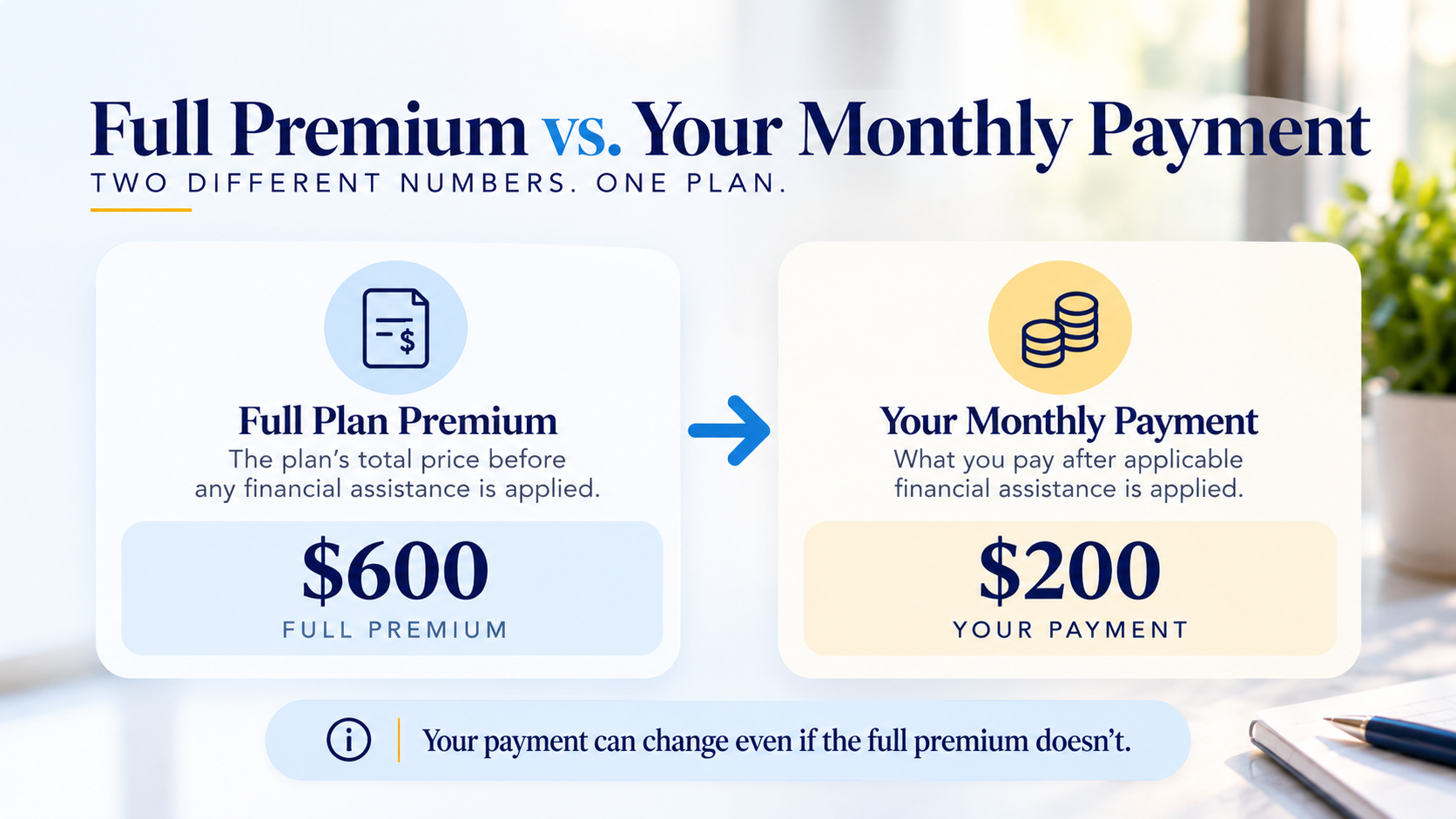
The full premium is the plan’s price before any applicable premium tax credit is applied. Your monthly payment is what remains after the assistance you use to lower that bill. Those numbers may move differently.
Here is a simplified illustration, not a quote or an eligibility estimate. If a plan’s full premium were $600 and the applied tax credit were $400, the household payment would be $200. If the full premium stayed at $600 but the applied credit became $350, the payment would become $250. The plan price did not rise in that example; the household contribution did.
A different household could see a price increase partly offset by assistance. Someone ineligible for a credit would have a different calculation. That is why asking only “How much did premiums rise?” can miss the issue you actually need to understand.
How can assistance change?
Premium tax credits have eligibility and calculation rules. Expected household income, household composition, other qualifying coverage, and the price of the benchmark plan can affect the result. The benchmark used in the calculation is generally the second-lowest-cost Silver plan applicable to the coverage family; it may not be the plan you choose.
Temporary expanded tax-credit eligibility applied for tax years 2021 through 2025. Do not assume an old assistance estimate applies to 2027, or that every payment change is caused by one policy change. Use current rules and the household’s actual information. Ask a qualified tax professional about tax consequences where needed.
For a self-employed person, an income estimate may require more care than looking at one paycheck. Use an honest estimate and the applicable Marketplace instructions; do not manipulate income to reach an advertised premium. Keep records of the information used and update the application when circumstances change.
Is healthcare itself getting more expensive?
National spending data provide context for why health insurance can face cost pressure. CMS reports that U.S. health spending grew 7.2% in 2024. Hospital spending grew 8.9%, and prescription drug spending grew 7.9% that year.
These are historical spending figures, not 2027 premium forecasts. Spending reflects both prices and the amount and type of care used. A national trend cannot explain a particular renewal notice by itself, and none of these percentages should be applied to your bill as if they were your carrier’s rate increase.
Insurance spreads expected costs across a covered population. Your own light use of care does not mean the plan had no costs to fund. At the same time, broad cost pressure does not mean every available option becomes more expensive for every person. Compare what is actually available to you.
What should I review before renewing?
Begin with your current renewal notice and current Marketplace information for next year. Write down both the full premium and the payment after any assistance. If a number is unclear, ask what it represents.
Then review:
- Expected household information and eligibility for assistance.
- The exact 2027 plan and its service area.
- Doctors, hospitals, prescriptions, and pharmacy details.
- Deductible, copays, coinsurance, and applicable out-of-pocket maximum.
- Care you anticipate and questions about coverage requirements.
This is a preparation checklist, not a way to guarantee future costs. A plan comparison should make assumptions visible. It should also identify information still needed before you rely on an estimate.
Is switching to a lower premium enough?
A lower recurring bill can help a household budget. It is still worth checking what happens when you use the coverage. Consider the doctor visits, prescriptions, and services that matter to you before treating the monthly price as the whole decision.
Ask which costs count toward the plan’s out-of-pocket maximum and which do not. Premiums are separate, and other excluded expenses may matter. Compare covered services under the specific plan instead of assuming that a maximum limits every dollar you might spend.
Source: https://www.healthcare.gov/glossary/out-of-pocket-maximum-limit/
Suppose a lower-premium option changes the way a frequently used service is paid for. You may prefer it after comparing the details, or you may decide the tradeoff does not fit. Neither conclusion can be made honestly from the premium alone. The point is to understand the choice before you make it.
When should I start?
HealthCare.gov says applications and updates for 2027 coverage open November 1. Use this time to prepare, then review current prices and eligibility as they become available. Check the current deadline with the Marketplace serving your state and allow time for questions and the steps needed to start coverage.
Source: https://www.healthcare.gov/quick-guide/dates-and-deadlines/
Do not confuse that schedule with Medicare’s fall window or an employer’s benefits deadline. If you are losing coverage or experiencing another life change, ask whether separate enrollment rules apply to you rather than waiting for a date intended for someone else.
Frequently asked questions
Can my payment rise even if the plan price stays the same?
Yes. If the assistance applied to your premium changes, your remaining payment can change. Check both numbers.
Should I use last year’s income estimate again?
Review the information expected for the coverage year and follow current Marketplace instructions. An unchanged estimate should reflect your actual expectations, not convenience.
Does a higher payment mean my coverage improved?
You cannot conclude that from the payment. Read the plan documents and compare the benefits, access, and cost-sharing details.
Can I use this explanation for Medicare or my employer plan?
Some cost concepts are useful, but those coverage types have different rules. Ask for a review appropriate to your coverage.
Your next step
Use NBP’s Marketplace Renewal Worksheet to organize your payment, coverage, and household questions before comparing options. National Benefit Plans can help explain available coverage from carriers it represents and identify what deserves a closer look.
Get the Marketplace Renewal Worksheet
National Benefit Plans | Independent. Local. Experienced.
Life Changes. Your Coverage Should Too.
This article provides general educational information, not personalized insurance, tax, legal, or medical advice. Eligibility, financial assistance, benefits, and costs vary by coverage and circumstances. Use current Marketplace information and consult an appropriately qualified professional for individual guidance.
Download our Worksheet
Use this worksheet to help you during your review process.

For over 30 years, NBP has been dedicated to the well-being of clients and the success of agents by always striving to do the right thing and caring for everyone as if they were family. We have offered the best national and local carriers offering top-notch, affordable healthcare coverage for individuals, families and groups, including supplemental Medicare plans.
Schedule an appointment: https://calendly.com/nbp-agents
Follow me on LinkedIn: LinkedIn